Video: A hot-air balloon ride over Babcock Ranch
A hot-air balloon ride over Babcock Ranch
Morgan Hornsby, morgan.hornsby@naplesnews.com
Florida offers lots of real estate choices.
History buffs might choose St. Augustine, a northeast Florida town billed as “the oldest continuously occupied settlement of European and African-American origin in the United States.”
Those fascinated with the supernatural might gravitate to Cassadaga, a small community of psychics between Orlando and Daytona Beach.
And for those who want to reduce their environmental footprints and live as one with nature, there’s Babcock Ranch, which stands in stark contrast to many of the norms in Florida’s development industry.
A Sunshine State town powered by the sun
Babcock Ranch, nicknamed “the Hometown of Tomorrow,” is located in the southwestern part of the state, a short distance from the winter home of inventor Thomas Edison.
Like Edison, who became famous for refining and harnessing electricity for a variety of uses, Babcock Ranch’s planners try to use energy as efficiently as possible.
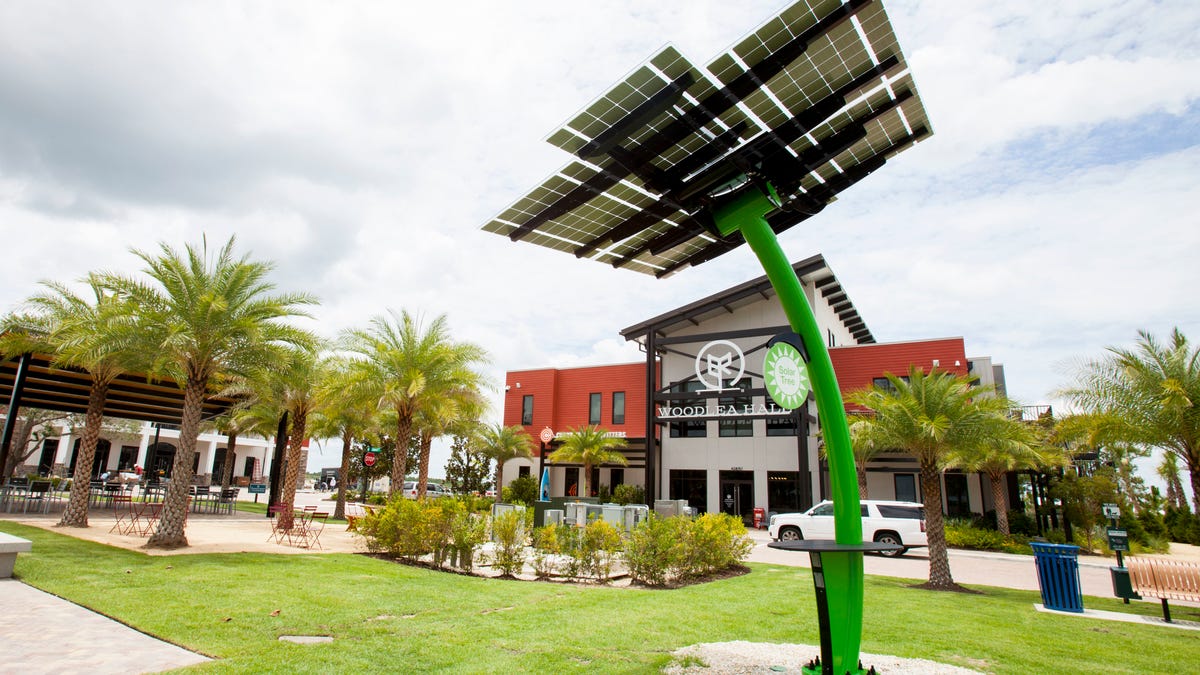
The main power source is a solar farm that generates all the electricity the community needs during daylight hours. (At night, solar energy stored in batteries at the site is supplemented by electricity generated by natural gas turbines at an offsite location.)
It’s unusual for a newly built community to provide its own power source, particularly a renewable one.
Going solar isn’t Babcock Ranch’s only innovation. On a recent tour, I saw features throughout the 91,000-acre property designed to promote sustainability and enhance livability.
To provide an alternative to car trips, the trails that snake throughout the community are wide enough for several people to walk abreast, or ride bicycles or scooters. Recycling bins are stationed next to trash cans along the routes. In public parking areas, there are numerous recharging stations for plug-in hybrids and electric cars.
Homes within the community are equipped with charging stations, too. Homes and businesses within the community are designed to meet Florida’s “green” building standards, with a focus on water and energy conservation.
Land maps dating to the 1940s were consulted to avoid building in areas historically prone to flooding. All homes are built at least 3 feet above street grade, with filter marshes filled with abundant muhly grass to handle stormwater runoff. Lake levels are carefully monitored and controlled with weirs and pumps.
Many developments in Florida rely on fill dirt to create buildable lots out of low-lying areas, but it works only as long as Mother Nature doesn’t wash that dirt away.
Most of the community - roughly 73,000 acres - is intended to remain as a nature preserve after buildout. That gives the feeling of development sprinkled within a natural area, and not the other way around.
In Florida, a more common practice is to bulldoze everything in sight, then plant a few small trees as replacements. Subdivisions often have names that are ironic because they describe what they used to be, like “Ospreys Nest” or “Turtle Refuge” or whatever.
None of Babcock Ranch’s innovations would matter if it weren’t an attractive place to live. But it is, with tidy homes - including a mix of single-family, townhomes and apartments - on neatly manicured lots. Businesses and entertainment venues are located within walking distance of the homes, making Babcock Ranch a “self-contained” community where driving is kept to a minimum.
Former pro football player wanted outdoors utopia
Syd Kitson, the person who brought Babcock Ranch to life, doesn’t fit the stereotypical image of a frail, sandals-wearing hippie. He’s a former professional football player for the Green Bay Packers and Dallas Cowboys.
After growing up in a small town in the Northeast, he told me, he wanted Babcock Ranch to be a walkable community that was in sync with its natural surroundings.
“To me, it made all the sense in the world,” Kitson said of his effort to make a small slice of the universe a better place.
While he acknowledged that a development like Babcock Ranch is tougher to plan than a traditional cookie-cutter subdivision - “If it were easy, I guess everybody would be doing it,” he said - it’s much simpler to incorporate environmental elements into a community that’s being built from the ground up than it would be to add them later.
“Babcock Ranch was a blank sheet of paper, so we could do it right from the beginning,” Kitson said.
Home prices in Babcock Ranch start in the $200,000s, and the cheapest monthly rents are around the $1,500s. Those aren’t exorbitant, compared with other Florida real estate.
Florida could learn from the hurricane preparedness
There’s also another big bonus to living in Babcock Ranch: Since construction began a decade ago, the community has proved to be highly hurricane resistant.
When Hurricane Ian rolled through in 2022, it caused an estimated $50 billion to $65 billion in property and infrastructure damage in Florida, South Carolina and North Carolina. In nearby Fort Myers Beach, 97% of the buildings were damaged or destroyed.
About 2.7 million people lost power during the storm. None of them were in Babcock Ranch, which is protected with underground power lines and hardy building standards. The community sustained only minimal storm damage during Ian and other hurricanes that have struck the area.
So, in addition to feeling good about helping the environment, homeowners there can be reasonably assured that tropical storms won’t blow their most prized possessions to smithereens.
Babcock Ranch is still a work in progress.
A second town center is being built to complement the shopping and entertainment options available at Founder’s Square. Florida Gulf Coast University is building a satellite campus there. Tampa General Hospital is opening medical facilities there. A church broke ground recently, and new office and industrial spaces are in the works.
Babcock Ranch is designed to accommodate about 60,000 residents when construction is complete, up from the 12,000 to 15,000 who live there now.
The good news, as Kitson sees it, is that Babcock Ranch doesn’t have to be the last of its kind.
“I think it can be replicated all over the country,” he said. “Innovation is really hard, but it can be done.”
Blake Fontenay is USA TODAY’s commentary editor.
{“uri”:“theledger.com”,“dataType”:“news”,“title”:“The Ledger”,“description”:“The Ledger family of publications is your indispensable source of news and information about Central Florida’s Polk County. Mobile: http://t.co/bJ29tYtvwI”}theledger.com