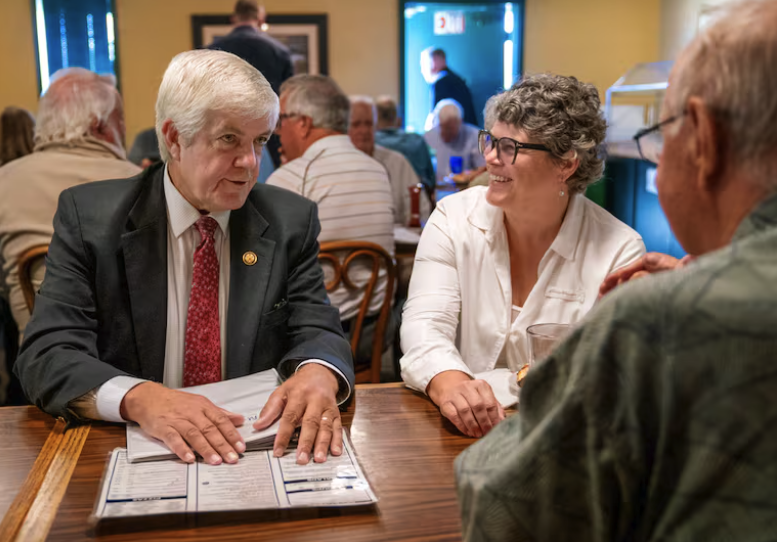
JOHN DAY – Oregon’s only Republican Congressman on Monday, Aug. 25, visited the Blue Mountain Eagle to discuss everything from the “Big Beautiful Bill” to immigration, Medicaid and the extent of presidential power.
Bentz voted in support of the Big Beautiful Bill and claimed its passage helped stave off a recession. Bentz said Medicaid needs a massive overhaul, there needs to be a middle ground regarding deportations and the president is allowed to undertake controversial measures or actions so long as they are within his power.
Bentz is on a swing through his district, but he is not holding public town halls, instead opting for smaller, controlled engagements. The stop in John Day came a few days after he was at The Bulletin in Bend.
Bentz said the way Medicaid works in Oregon as the Oregon Health Plan in flawed. He identified the expansion of Medicaid in Oregon following the passage of the Affordable Care Act as a significant financial burden to Oregon.
He took aim at reports some rural hospitals in Oregon were in danger of closure due to Medicaid cuts within the Big Beautiful Bill. Bentz said the expansion of Medicaid has led to a large number of “able-bodied” people using the program while costing the federal government more money. He added Oregon is the only state that provides most adult recipients with more than two-years of continuous eligibility.
Bentz said the state and federal government cover Medicaid costs and Oregon’s share of that bill was right around 50/50, with Oregon paying half of the cost and the federal government covering the other half. Bentz said the rate for those added after the expansion is around 10/90 with the federal government paying about 90% of the cost and Oregon paying 10%.
“Immediately, there was a bias inside Medicaid favoring the new people who were able-bodied,” he said.
According to the Kaiser Family Foundation, a nonpartisan organization focused on health policy, 41 states and Washington, D.C., have adopted Medicaid expansion. Its enrollees make up nearly a third of all Medicaid enrollment and one-fifth of total Medicaid spending.
The Kaiser Family Foundation estimates a cap on the Medicaid expansion population could shift $246 billion in costs to states during the next 10 years. State spending on Medicaid would see increases as low as 4% and as high as 20% in expansion states.
The Congressional Budget Office estimates a roughly $911 billion reduction in federal spending on Medicaid during the next decade following the passage of the Big Beautiful Bill. That has led to speculation that rural hospitals that rely heavily on Medicaid funding could close.
In Oregon, four rural hospitals – Silverton, Providence Seaside, St. Charles Madras and Good Shepherd Medical Center in Hermiston – have all been identified as in grave danger of closure. but Bentz said that is simply not the case.
Bentz said he met with representatives at the Madras St. Charles branch and the Prineville branch and was told the hospital can manage comfortably through the changes that have been suggested. Bentz went on to say that no hospital he has met with has said they are worried about having to close their doors.
“What they’ve said is we don’t know yet what’s going to happen,” he said.
St. Charles Madras on July 28 put out a community newsletter stating unequivocally it is not closing. Art Mathisen, the CEO of Good Shepherd Health Care System, in a community letter July 16 criticized the report about the hospitals closing as flawed for using just two criteria to determine the financial health of hospitals.
“Good Shepherd is unequivocally NOT at risk of closing, nor are we in any financial distress,” Mathisen stated.
Bentz pointed to proposed changes to Medicaid, such as work requirements, regular checks on eligibility and provider tax reductions taking effect one to two years into the future.
Bentz pointed to H.R. 2 the Secure the Border Act of 2023, saying there was a provision in that bill for the -verify program that would have penalized those knowingly hiring illegal immigrants or people with questionable citizenship status.
That bill passed in the House and failed in the Senate. Bentz said he is sure if e-verify were adopted throughout the country there would be stiff enough penalties for hiring illegal immigrants to discourage the practice.
However, he said, Arizona and other stated that use e-verify do not enforce it.
Bentz said he knows farm workers are leaving the country and there has to be a median between deporting everybody and letting everyone stay here illegally.
“If the work is going to be done, we have to find a middle ground,” he said. “Otherwise the work will not be done.”
Bentz highlighted a sharp rise in motel costs during the past few years and said food and construction prices could see similar rises if a compromise for workers isn’t reached.
The Committee for a Responsible Federal Budget, a nonpartisan, nonprofit entity, estimates the Big Beautiful Bill will add $4.1 trillion to the national debt on the low end and $5.5 trillion to the debt on the high end.
Bentz acknowledges these numbers but said not passing the bill could’ve been far worse for the economy.
“They’re ignoring the seven million jobs it’s estimated we would have lost and the high probability of us going into a recession,” he said. “If that happens, it’ll have an even more damaging impact on our deficit.”
Bentz also claimed there would have been a 22% increase in taxes across the board had the president’s tax cuts not been extended. He also took issue with the CBO’s estimate of a 0.5% rate of GDP growth over the next decade, saying our economy has never grown that slowly during a 10-year period.
Bentz said the economy would realistically grow at a rate of 2.8% for the next decade, which would help offset the bill’s impact on the budget.
Independent estimates largely reflect the CBO’s GDP growth estimates, however. The highest GDP growth estimates for the next decade come from the Tax Foundation, which predicts 0.8% GDP growth on the low end and 1.2% growth on the high end.
The Council of Economic Advisors, an agency within the Executive Office of the President, is the outlier. The council predicts a 4.6%-4.9% GDP increase by 2028 and a 2.4%-2.7% GDP increase by 2034.
Bentz touted aspects of the Big Beautiful Bill that are beneficial to farmers and ranchers, including changes to the death tax, changes to crop insurance programs and $10 billion in tax cuts for farmers. Bentz also highlighted the child tax credit increasing to $2,200, no taxes on tips, overtime pay or car loan interest and additional tax relief for seniors as positive aspects of the bill.
Bentz highlighted President Donald Trump’s willingness to push the envelope.
“He always has,” he said.
Pushing the envelope has led to accusations of executive overreach, including the president’s recent executive order criminalizing flag burning, an act the Supreme Court has ruled is as free speech.
Bentz said he’d just learned about the executive order shortly before his arrival for the interview. He said he would need to look at the order before deciding on its legality.
“My initial response would be just like yours, that the Supreme Court has spoken and this is a way of exhibiting free speech and is protected under the First Amendment,” he said. “I’d like to see what the order says … I’d like to understand what the legal foundation for it is.”
Another legal minefield is the prospect of a third Trump presidential run in 2028. Trump 2028 merchandise is available now for purchase, and there are photos of the president showing Trump 2028 merchandise to Ukrainian President Volodymyr Zelensky.
Bentz said outright that he would not support a third Trump term were he to run for office again in 2028.
“The Constitution says you get eight years, and he is in his second four now,” Bentz said. “The answer is no, I would not. It’s eight years. There’s a really good reason for that.”
Bentz also commented on the president’s strategy of threatening to withhold funds from states that do not agree with his immigration policy. The Obama administration made a similar play with adherence to Title IV, and the right was furious with some claiming the move could hand the presidency to Trump.
Bentz said he would question the assumption that all people on the right are OK with what Trump may do, adding he’d like to look at whether the president has that power according to the Constitution. Bentz also hinted at the president tailoring and targeting withheld funds so they don’t impact his supporters.
“I’d probably be going to the president and saying, ‘Hey, my district voted for you … if you’re going to be doing this, you better tailor it so at least it’s targeted on those that you think don’t support you,’” he said. “But we do out here.”
Bentz said restricting access based on political affiliation is the way things work.
“I’m going to say you need to spend 12 years in Salem, Oregon, and see how it works,” he said. “I’m going to say that very often, political positioning wins out over what should happen, and that very often, people of different parties favor their parties and not others. That’s not a good thing, but it certainly is a predicable thing.”
{“uri”:“eastoregonian.com”,“dataType”:“news”,“title”:“East Oregonian”,“description”:“News and information about Eastern Oregon, Pendleton, Hermiston and surrounding communities”}eastoregonian.com