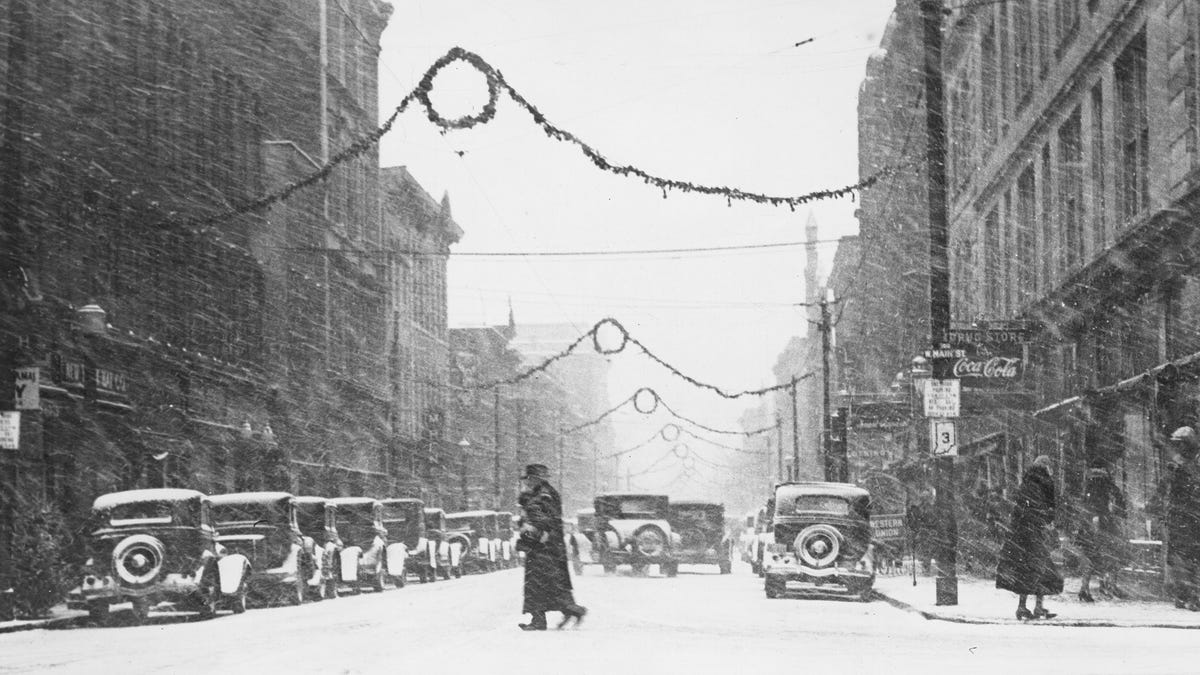
MUNCIE, IN – The Christmas of 1930 in Muncie was a subdued affair.
A year of economic upheaval had passed since the Wall Street stock market crash in October of 1929. Munsonians, like Americans elsewhere, were losing their jobs. By Christmas 1930, U.S. unemployment had risen fivefold, reaching roughly 12% of the working population.
Many knew the economy was in a deep recession in late 1930, but no one yet called it the Great Depression. The worst was still months ahead.
But grim economic statistics soured the Christmas mood that year. Muncie’s Free Employment Bureau, a local relief agency, registered 1,400 Munsonians out of work in mid-December of 1930. Around this time, the Chamber of Commerce estimated that Delaware County factory payrolls were down 20% from the previous year.
As a result, the spirit in Muncie that holiday season was one of charitable giving.
In a Christmas Eve editorial, the Evening Press wrote that “Muncie, for the first time in many years, has turned its attention to the relief of those in need … with thoughts in mind of the more unfortunate, many citizens will observe their holiday quietly.”
A major relief effort was coordinated by Muncie’s Social Services Bureau, the Muncie Star Christmas Cheer Club and the Salvation Army. Together, they delivered more than 1,000 food baskets across the city, along with coal (for furnaces), candy, blankets, toys and clothing. The baskets were assembled by Muncie police and firefighters, Ball State Teachers College sororities and fraternities, many churches and fraternal lodges.
However, it wasn’t all doom and gloom that holiday season. The Muncie Bearcats crushed the Martinsville Artesians 29-14 at the Field House on Dec. 23. “So tight was the Muncie defense,” the Press told readers, “that the Artesians failed to connect for a single point during the second quarter.”
Local papers also pushed tickets during Christmas week for the Big Four Tournament, a daylong basketball competition held on New Year’s Day in the Field House. The event matched Muncie Central against Logansport, Kokomo and Frankfort.
Later that spring, the same Bearcat team would go on to win the state basketball championship. It was one of eight IHSAA titles Muncie Central boys claimed during the 20th century.
The city’s infrastructure was also improving in 1930. A new concrete arched bridge carrying Washington Street over the White River opened just before Christmas. The expanse connected the Old West End to Riverside. Designed by county engineer Charles Armintrout, the span replaced an old metal truss bridge that had become unsafe.
Many north-siders took the new bridge into downtown Muncie, which was bustling in the days leading up to Christmas. Local merchants “were pleased with the volume of business,” the Star wrote. But there “were no spectacular sales reported.”
The city’s grocers offered deep discounts on holiday accoutrements. Buehler Brothers sold whole ducks for 22 cents a pound, geese for 2 cents¢ and chickens for 24 cents at their store at 321 S. Walnut St.
Managers at all four Muncie Piggly Wiggly locations slashed staples by 15% and sold holiday food baskets for $2.50. The Ideal Fish Market on Charles Street was selling “fresh, home killed rabbits” for 39 cents each, along with frogs and oysters.
On Christmas Eve, downtown “sidewalks overflowed and traffic jammed as last-minute purchasers of gifts poured into the stores.”
Out in the neighborhoods, Munsonians trimmed their houses in typical fashion, although “in no part of the city are decorations as numerous as last year,” according to the Evening Press. Despite the cutbacks, many homes had “lighted Christmas trees conspicuous from the street.”
Electric Christmas lights became popular in the 1920s and mainstream in and on American homes during the 1930s. The Muncie Star observed “electric tapers from many windows and gaily decorated Christmas trees on porches and in homes” casting “colored beams across the walks and streets.”
Munsonians in Riverside and Normal City leaned hard into outdoor decorations that season. The Star wrote of “festoons of spruce boughs, holly and tinted bulbs form the façade of many homes along College, Riverside and University avenues as well as North Street, where the electrical display is especially vivid.”
On Riverside Avenue, a tethered airplane and blimp flew over the lawn at E.B. Baltzley’s house, vice president of Borg Warner. Both “airships” were covered in Christmas lights. A dummy Santa Claus sat “at the throttle of the airplane and a number of persons may be seen in the lighted cabin of the dirigible.”
Many Muncie churches swelled as Christmas Eve drew to a close. The Revs. Edward Houlihan and Edgar Cyr celebrated vigil Masses at St. Lawrence and St. Mary, respectively. The Rev. Arthur McDavitt led a midnight service at St. John’s Universal at the corner of Madison and Jackson streets. Over at Shaffer Chapel, congregants gathered for a Christmas Eve pageant titled: “The Abiding Christ.”
But not everyone kept the vigil quite so reverently. Late on Christmas Eve, Muncie police raided two lively gambling dens – one on South Hackley and the other at the Club Cigar Store on South Walnut. There, officers nabbed a half-dozen men shooting dice, courtesy of proprietor Vernon “Plug” Walburn.
On Christmas Day, Santa visited the children’s ward at Ball Memorial Hospital. Old Saint Nick passed out stockings stuffed with fruit, candy and nuts. He later hosted a party at the Children’s Home on the Muncie-Yorktown Pike.
Then as now, the city mostly shut down on Christmas. Several churches offered morning services. A half-dozen downtown grocery stores opened for a few hours in the morning, but many Munsonians stayed home.
Movie theaters opened later in the day, accommodating hundreds of afternoon and evening patrons. The Liberty ran “The Texan,” starring Gary Cooper. The Rivoli played “The Princes and the Plumber” and the Wysor Grand reran the 1921 silent-comedy classic, “The Perfect Fool.” The Orpheum Theater screened “It’s a Great Life,” an early sound film.
Wet snow and ice fell that night, causing minor traffic accidents across greater Muncie. The weather, however, didn’t deter hundreds of teenagers who gathered in the ballroom at Hotel Roberts for the Kappa Alpha Phi sorority dance, which the Star called “one of the outstanding formal dances of the holiday season.”
I wish you and yours a very Merry Christmas and the happiest of New Years.
Chris Flook is a Delaware County Historical Society historian and senior lecturer of Media at Ball State University.
{“uri”:“thestarpress.com”,“dataType”:“news”,“title”:“The Star Press”,“description”:“Trusted news source for East Central Indiana. https://t.co/HEnCzSqWVA\nhttps://t.co/DEsWb25GQY”}thestarpress.com