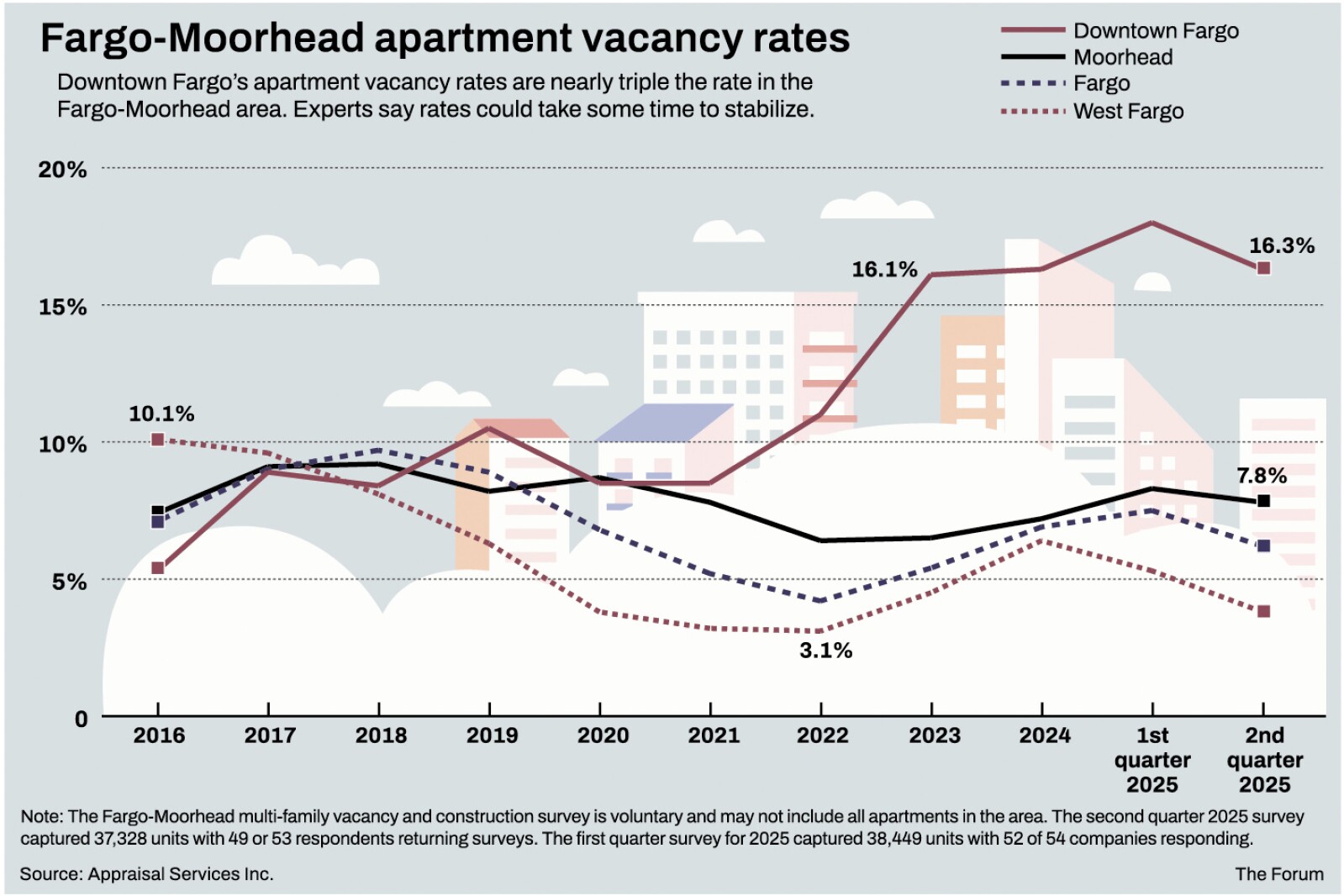
FARGO – Downtown Fargo apartments are nearly three times emptier than the rest of the metro area, but experts say vacancy rates in the heart of Fargo could stabilize in the coming years.
Just over 16% of downtown apartments sat empty in this year’s second quarter, which ended in June, according to a survey conducted by Appraisal Services. That’s unchanged from 2024 and down from the first quarter vacancy rate of 18%, according to data from the Fargo real estate valuation company.
A stable vacancy rate ranges from 5% to 8%, said Petter Eriksmoen, president and co-owner of Appraisal Services. Developers like to see apartment buildings stabilize about six to nine months after being built, but it’s unclear how much time will pass before downtown rates come down, he said.
“Those just are sort of captive to the fact that they’re just aren’t as many renters as there are available units right now,” he said of downtown apartments.
The vacancy rate in the metro area was 6.2% in the second quarter, down from both 7.4% in the first quarter and 6.9% in 2024.
Fargo’s vacancy rate closely mirrors the overall metro, according to an analysis of Appraisal Services data dating back to 2016. Until 2019, the downtown Fargo vacancy rate was below the rest of the Fargo-Moorhead area.
The downtown rate then climbed to more than double the rest of the metro, showing signs developers may have overbuilt in the neighborhood, said Jim Gilmour, strategic planning and research director for the city of Fargo.
“There’s maybe a little bit of an overbuild there in part because so many units came online,” he said. “It’ll just take a while for those to absorb.”
The amount of downtown apartments built in recent years has driven up the vacancy rate, Eriksmoen said. Of the apartments built since 2001 in downtown, 80% were constructed in the last decade, according to data from the city of Fargo. Almost half were built in the last five years, according to city data.
The downtown rate in 2019 was 10.5%, or two percentage points above the metro rate, according to Appraisal Services.
“When you take a market that’s already at a point where there’s more supply than there is demand and you just add more supply, until demand can catch up with supply, you’re just going to continue to see that vacancy rate rise,” Eriksmoen said.
The Kilbourne Group, one of downtown Fargo’s most prominent developers, said the vacancy rate drop from the first quarter suggests the momentum of vacancy rates is changing. More people are interested in downtown office and retail space, Kilbourne Marketing Director Sami Harwood told The Forum.
That signals a positive trend, which strengthens the demand for living downtown, she said.
“Downtown vacancy will stabilize as more residents choose to make the neighborhood their home,” she said.
Every three months, Appraisal Services surveys apartment vacancy rates in Fargo, West Fargo, Moorhead, Dilworth and Horace. The survey doesn’t capture all apartments in the metro, but it does paint a picture of availability.
The second quarter survey, also the latest, was published Nov. 11. It captured 37,328 units in the metro, with 49 of 53 rental management companies responding. In the first quarter, 52 of 54 companies responded, with 38,449 apartments reflected in that survey, according to Appraisal Services.
Appraisal Services captured 2,158 downtown units in the first quarter survey this year, suggesting 389 units were empty during that time. The second quarter survey included about 2,100 downtown apartments, indicating 342 were empty.
The 2020 first quarter survey reflected 35,456 units managed by 63 of 64 management companies in the metro. Downtown had 1,561 units, about 600 less than the 2025 first quarter, according to Appraisal Services.
City records show developers have built 1,839 apartment units in downtown Fargo since 2001. Downtown building picked up in 2015, shortly after the city extended its Renaissance Zone program in 2014, Gilmour said.
The program, initially started in 1999, let Fargo issue property tax breaks for downtown businesses and apartments. It was extended again in 2019 and 2024.
The city saw steady growth in apartment building from 2015 to 2020, when a building boom started.
Developers in downtown Fargo built nearly 850 apartment units in the last five years, including Kilbourne’s Mercantile with 100 units, the Kesler with 109 and the Landing with 152.
The latest approved project for downtown Fargo is another Kilbourne project. Construction on the Avery, which is connected to the NP Avenue parking ramp and the Fargo-Moorhead Community Theater, will boast 168 apartment units when it opens next year.
The Avery isn’t the last apartment complex that could come to downtown. The Annex Group, of Indiana, is in the process of gaining city approval for a 262-unit apartment at 11 12th St. N. called the Central at the Horizon.
Compared to North Dakota, Fargo has a high ratio of renters to home owners, according to 2022 U.S. Census data compiled by the city. About two-thirds of North Dakotans own a home, while 56% of Fargo residents rent, the data shows.
Fargo is unique compared to other cities of its size since a developer – Kilbourne – has largely dedicated itself to downtown projects, Eriksmoen said. Other developers have built downtown, but not as exclusively as Kilbourne.
Enclave, which developed downtown’s 300lime in 2016 and the Mosaic in 2019, declined a request for an interview regarding this story. Attempts to reach Campbell Properties, another downtown rental company, were unsuccessful.
Several factors contribute to high vacancy rates in downtown, including evolving lifestyle preferences and amenities that renters are seeking, Harwood said.
Eriksmoen noted in his report that the downtown area generally has the highest prices per square foot, though Harwood argued that downtown rents are comparable with other parts of the city, based on Kilbourne’s research.
People may not look at downtown apartments because of the misconception of higher rents, she said.
Some people also are concerned with safety in downtown, and people who beg others for money can deter renters, Gilmour said.
“I think that is a factor in the vacancy rates,” he said. “We just can’t deny it. The Downtown Engagement location has brought more people into downtown that are more prone to heckle people who live there, so that’s a real problem.”
Perceptions can influence potential renters, Harwood said in recognizing safety concerns.
“We’re encouraged by the work the city is doing to improve the overall downtown experience and address some of those broader perceptions,” she said in calling downtown a vibrant neighborhood. “Anything that helps create a stronger environment for people who live, work or visit downtown is a positive step.”
Harwood said it’s a “good time to rent” in the downtown area, adding that Kilbourne is optimistic about the current market.
“There is steady interest in living downtown, and we’re excited for people to continue rediscovering the range of housing options here,” she said. “Our focus is on contributing to a vibrant and welcoming downtown community.”
High vacancy rates won’t last forever in downtown Fargo, Eriksmoen said. He said he doesn’t see a cause for concern since Fargo is an economic hub.
“I think part of it is slowing the supply growth in that market and just giving it time to absorb,” he said. “I think it really is more of waiting for demand to catch up with supply.”
{“uri”:“inforum.com”,“dataType”:“news”,“title”:“INFORUM”,“description”:“INFORUM your best local source for news, sports, and weather in the Fargo-Moorhead area”}inforum.com