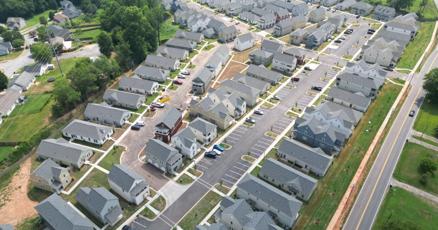
GREENVILLE – As thousands of people move here each year, pressure bears down on the housing market. Builders keep on building, but Greenville’s home prices keep climbing.
It’s a phenomenon seen across the country. It’s been reported constantly in the news. But when it comes to Greenville, the metro area has seen a key market explode in the years after the onset of the COVID-19 pandemic: build-to-rent homes.
Typically described as one family per building, instead of many families like an apartment building, the Greenville-Anderson-Greer metro area saw a 750 percent increase in new build-to-rent homes completed from 2019 to 2024, according to Point2Homes, the research arm of Yardi, a company that makes real estate software.
Despite only having the 57th largest population, the Greenville-Anderson-Greer metro added more build-to-rent homes than all but 12 other U.S. metros during that period.
Developers of build-to-rent homes in Greenville include Advenir Oakley Capital LLC and Capstone Construction Corp., which recently completed a new project in the booming city of Greer. There’s also Tricon Residential, a subsidiary of the real estate investment behemoth Blackstone. The firm and its partners broke ground on nearly 100 townhomes near Simpsonville in August, with an executive saying the new rentals are designed to address the housing shortage as South Carolina grows.
Build-to-rent has been touted as a way for people who can’t afford to buy a home to be able to occupy a more comfortable and spacious place than an apartment.
Real estate investors, however, have come under fire for buying up existing properties and converting them to rentals, which removes supply from the market for homeownership opportunities, prices out families who can’t compete with investors’ financial power, and in turn, reduces chances for families to build wealth as economic inequality grows.
What’s driving build-to-rent housing in Greenville?
Todd Usher, the director of the real estate master’s program at Clemson University, said he’s heard from builders and developers that the Southeast – and especially Greenville – is “the bright spot in the country” for housing development.
Build-to-rent activity in the region has been spurred by high interest rates, a lack of housing stock and population growth, which are all driving home prices up, Usher said.
“People aren’t letting go of … their home with their 3 percent mortgage because they don’t want to lose that deal and go to a 7 percent mortgage,” Usher said.
That leads to fewer existing homes on the market – which hurts supply – and when coupled with the influx of new residents – which drives up demand – that pushes housing prices up, Usher said.
“With price appreciation and costs of new construction rising, is renting becoming more of an attainable solution for more of the population?” Usher said.
Rising housing costs are one draw for tenants in build-to-rent housing, said Jonathan Ellenzweig, executive vice president and chief investment officer with Tricon Residential. Not everyone can afford to buy their own home.
“What we’re trying to do is offer those people similar options to what a home buyer might see,” Ellenzweig said before a ceremony for the Simpsonville project.
Tricon already owns more than 400 single-family homes in the area, but this marks the company’s first build-to-rent project in the Greenville area.
“We like to be in places where there’s growing employment, then there’s going to be a growing population, and as a result, there’s a growing need for housing,” Ellenzweig said.
Homebuilders might be driven to build-to-rent for different reasons, Usher said. Companies tied with a major investment firm like Blackstone might look for return on investment and a longer hold on a property, he said.
“There are a lot of variables there that ultimately determine what their best product or product mix is, and, ultimately, that comes down to the goals of the fund or the people behind the project,” Usher said.
How quickly have build-to-rent homes grown in Greenville?
Major metros in the Sunbelt have led the sector’s growth, according to Point2Homes, which analyzed professionally managed communities of at least 50 units. Phoenix led the pack with 12,702 new units, while Dallas and Atlanta followed.
Greenville’s metropolitan area, which consists of Greenville, Anderson, Laurens and Pickens counties, added 1,904 new build-to-rent homes from 2019 to 2024.
That’s driven in part by population growth, which has morphed in recent years.
The broader Greenville-Spartanburg metropolitan area – which is a larger demographic region versus the one analyzed in the Point2Homes study – saw its net migration rate double during the pandemic.
From 2010 to 2019, the region saw 4,472 more people move there each year – but from 2019 to 2022, that exploded to 10,246 people, according to a report by commercial real estate firm Colliers.
Compared to before the pandemic, people moving to Greenville are wealthier and coming from a national array of major metros, compared to the previous influx from Southeastern cities.
That deluge of people contributes to growing pressure for resources across the board: housing, utilities and other infrastructure like roads.
Other pressures besides population have put pressure on the market, Usher said. Low mortgage rates that buyers locked in during the pandemic era have incentivized them to stay put, driving prices up for existing homes. Construction costs continue to rise, driving prices up for new homes.
People moving into town from more expensive markets might be drawn here by the relatively low cost of housing compared to major metros, Usher said. That creates an imbalance between newcomers and longtime residents.
“You’re like, 'I can’t sell what I’m living in now and go buy new. I’d just be swapping one thing for the other and maybe having to add money to it, right?” Usher said.
{“uri”:“postandcourier.com”,“dataType”:“news”,“title”:“Post and Courier”,“description”:“Your daily source for breaking news, crime alerts, sports, weather and opinion serving Charleston County, Dorchester County and Berkeley County.”}postandcourier.com