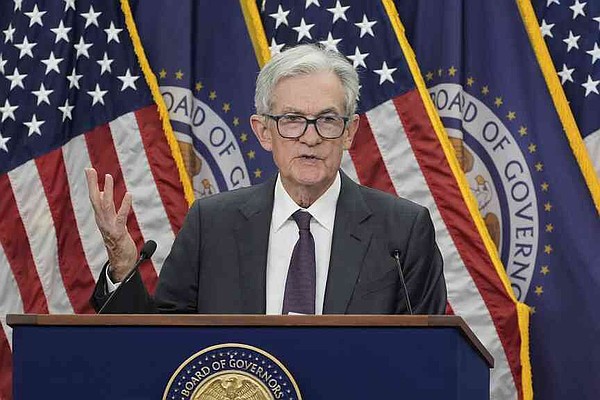
JACKSON HOLE, Wyo. – Federal Reserve Chair Jerome Powell on Friday opened the door ever so slightly to lowering a key interest rate in the coming months but gave no hint on the timing of a move and suggested the central bank will proceed cautiously as it continues to evaluate the impact of tariffs and other policies on the economy.
In a high-profile speech closely watched at the White House and on Wall Street, Powell said there are risks of both rising unemployment and stubbornly higher inflation. Yet he suggested that with hiring sluggish, the job market could weaken further.
“The shifting balance of risks may warrant adjusting our policy stance,” he said, a reference to his concerns about weaker job gains and a more direct sign that the Fed is considering a rate cut than he has made in previous comments.
Still, Powell’s remarks suggest the Fed will proceed carefully in the coming months and will make its rate decisions based on how inflation and unemployment evolve. The Fed has three more meetings this year, including next month, in late October and in December, and it’s not clear whether the Fed will cut at all those meetings.
“The stability of the unemployment rate and other labor market measures allows us to proceed carefully as we consider changes to our policy stance,” Powell said. That suggests the Fed will continue to evaluate jobs and inflation data as it decides whether to cut rates.
It also suggests that once the Fed starts cutting, it will not reduce interest rates quickly or by much if the economy evolves as expected. Powell reiterated Friday that he viewed the central bank’s policy settings as only “modestly” restrictive, meaning there is not too far to go in terms of interest rate reductions before hitting the Fed’s desired level. The central bank is aiming for a “neutral” setting that neither revs up the economy nor slows it down.
The stock market jumped in response to Powell’s remarks, with the broad S&P 500 index rising 1.5% in midday trading.
“We see Powell’s remarks as consistent with our expectation of” a quarter-point cut to the Fed’s short-term rate at its Sept. 16-17 meeting, economists at Goldman Sachs wrote in a note to clients. The Fed’s rate currently stands at 4.3%.
Powell spoke with the Fed under unprecedented public scrutiny from the White House, as President Donald Trump has repeatedly insulted Powell and has urged him to cut rates, arguing there is “no inflation” and saying that a cut would lower the government’s interest payments on its $37 trillion in debt.
Trump also says a cut would boost the moribund housing market. A rate cut by the Fed often leads to lower borrowing costs for mortgages, car loans and business borrowing, but it doesn’t always.
While Powell spoke, Trump elevated his attacks, telling reporters in Washington he would fire Federal Reserve board member Lisa Cook if she did not step down over accusations from an administration official that she committed mortgage fraud.
If Cook is removed, that would give Trump an opportunity to put a loyalist on the Fed’s governing board. The Fed has long been considered independent from day-to-day politics. The president can’t fire a Fed governor over disagreements on interest rate policy, but he can do so “for cause,” which is generally seen as malfeasance or neglect of duty.
Later Friday, Trump told reporters, referring to Powell, “We call him too late for a reason. He should have cut them a year ago. He’s too late.”
The president wants borrowing costs that are 3 percentage points lower than the current range of 4.25% to 4.5%. The Fed has opted to keep interest rates steady so far this year after a series of reductions in the second half of 2024.
Powell spoke at the Fed’s annual economic symposium in Jackson Hole, Wyo., a conference with about 100 academics, economists and central bank officials from around the world. He was given a standing ovation before he spoke.
Cook, who is also attending the conference, declined to comment on the president’s remarks.
TARIFFS, INFLATION
In his remarks, the Fed chair underscored that tariffs are lifting inflation and could push it higher in the coming months.
“The effects of tariffs on consumer prices are now clearly visible. We expect those effects to accumulate over coming months, with high uncertainty about timing and amounts,” Powell said.
The Fed might not have as much room to cut interest rates as many people and investors believe, because inflation is still a problem, according to Jon Hilsenrath, a senior adviser to StoneX Group, a Wall Street trading firm.
“That ‘proceed carefully’ phrase is important and intentional, as a signal to markets to not get carried away into thinking the Fed is going into this next phase with all guns blaring,” said Hilsenrath, also a visiting scholar at Duke University’s economics department who focuses on central bank issues.
Inflation has crept higher in recent months, though it is down from a peak of 9.1% three years ago. Tariffs have not spurred inflation as much as some economists worried, but they are starting to lift the prices of heavily imported goods such as furniture, toys and shoes.
Consumer prices rose 2.7% in July from a year ago, above the Fed’s target of 2%. Excluding the volatile food and energy categories, core prices rose 3.1%.
Powell added that higher prices from tariffs could cause a one-time shift to prices, rather than an ongoing bout of inflation. Other Fed officials have said that is the most likely outcome and as a result the central bank can cut rates to boost the job market.
The Fed chair said it is largely up to the central bank to ensure that tariffs don’t lead to sustained inflation.
“Come what may, we will not allow a one-time increase in the price level to become an ongoing inflation problem,” he said, suggesting deep rate cuts, as Trump has demanded, are unlikely.
“Of course, ‘one-time’ does not mean ‘all at once.’ It will continue to take time for tariff increases to work their way through supply chains and distribution networks,” he added.
Regarding the job market, Powell noted that even as hiring has slowed sharply this year, the unemployment rate remains low. He added that with immigration falling sharply, fewer jobs are needed to keep unemployment in check.
“This unusual situation suggests that downside risks to employment are rising,” he said. “And if those risks materialize, they can do so quickly in the form of sharply higher layoffs and rising unemployment.”
Powell also suggested the Fed would continue to set its interest-rate policy free from political pressure.
Fed officials “will make these decisions, based solely on their assessment of the data and its implications for the economic outlook and the balance of risks. We will never deviate from that approach.”
The upshot is that the Fed remains under pressure on both sides of its dual mandate for maximum employment and low, stable inflation. And the path forward isn’t clear cut as Powell enters the final months of his term as chair, which expires in May.
“He’s in this really difficult situation,” said Rob Waldner, fixed income chief strategist and head of macro research at Invesco, who said he expects the Fed will nonetheless cut two to three times this year into next. “He wants to finish up his term and walk away as somebody who delivered a great outcome for the U.S. economy and was not swayed by politics.”
Though investors’ expectations that the Fed will resume cutting next month grew higher on Friday morning, Fed officials had appeared increasingly divided about what to do, with many wary of rising price pressures. The central bank’s short-term benchmark rates trickle through the financial sector to influence what millions of consumers and businesses pay for mortgages and other types of loans.
“With the data that I have today, I do not see the case for cuts,” Cleveland Fed President Beth M. Hammack said in an interview Thursday.
She remains concerned about inflation, which has been well above the Fed’s target for more than four years and stopped declining about a year ago. More recently it has began to rise again. When the Fed started a series of rate cuts last September, inflation was declining, but the central bank paused those cuts at the beginning of this year, saying officials needed time to assess how Trump’s trade and other policies would weigh on the economy.
Now, she said, “the trend is in the wrong direction, not the right direction.”
Boston Fed President Susan M. Collins, who has characterized her approach as “actively patient,” declined to say how she might vote in September with a month more of inflation and jobs data. But she acknowledged the possibility of cuts if the labor market continues to soften.
“If I were to see that in the data … it may soon be appropriate to begin dialing back that modestly restrictive labor market stance that we have,” she said in a separate Thursday interview.
STRATEGY DETAILED
Also on Friday, Powell laid out new details about the Fed’s overarching strategy for setting monetary policy, which is reviewed every five years. The changes amount to a gutting of the 2020 version, which was rolled out at that year’s Jackson Hole conference and marked a sea change in the way the central bank thought about its economic goals and how to achieve them.
“A key objective has been to make sure that our framework is suitable across a broad range of economic conditions,” he said. “During this period, we saw that the inflation situation can change rapidly in the face of large shocks.”
The 2020 framework established that the Fed would temporarily tolerate periods of higher inflation to make up for past stretches when it was too low, with an aim to average 2% over time. This “flexible average inflation targeting” approach was a direct response to the environment that the central bank found itself in after the global financial crisis, with inflation languishing below the Fed’s target and interest rates close to zero.
Inflation started to take off on the heels of the new framework taking effect and eventually reached a four-decade peak in 2022, rendering the strategy inoperable.
Powell on Friday confirmed the Fed would scrap what he described as the earlier “makeup strategy,” adding “The idea of an intentional, moderate inflation overshoot had proved irrelevant.”
He also said the Fed would reverse course on a stipulation in 2020 that it would set monetary policy with an aim to address “shortfalls” of employment from its maximum level, rather than by “deviations.” At the time, that meant it would not hasten to raise interest rates just because joblessness had fallen; it would need to see clear evidence that inflation was rising in a sustainable way.
As part of the overhaul, the Fed chair said the central bank had scrapped the “shortfalls” language because its use was “not intended as a commitment to permanently forswear preemption or to ignore labor market tightness.”
Information for this article was contributed by Christopher Rugaber of The Associated Press, Colby Smith of The New York Times and by Andrew Ackerman of The Washington Post.
{“uri”:“nwaonline.com”,“dataType”:“news”,“title”:“Northwest Arkansas Democrat Gazette”,“description”:“The Northwest Arkansas Democrat-Gazette features a comprehensive collection of news stories, including breaking and developing at http://t.co/HiHdfAwlk9.”}nwaonline.com